FR
FR
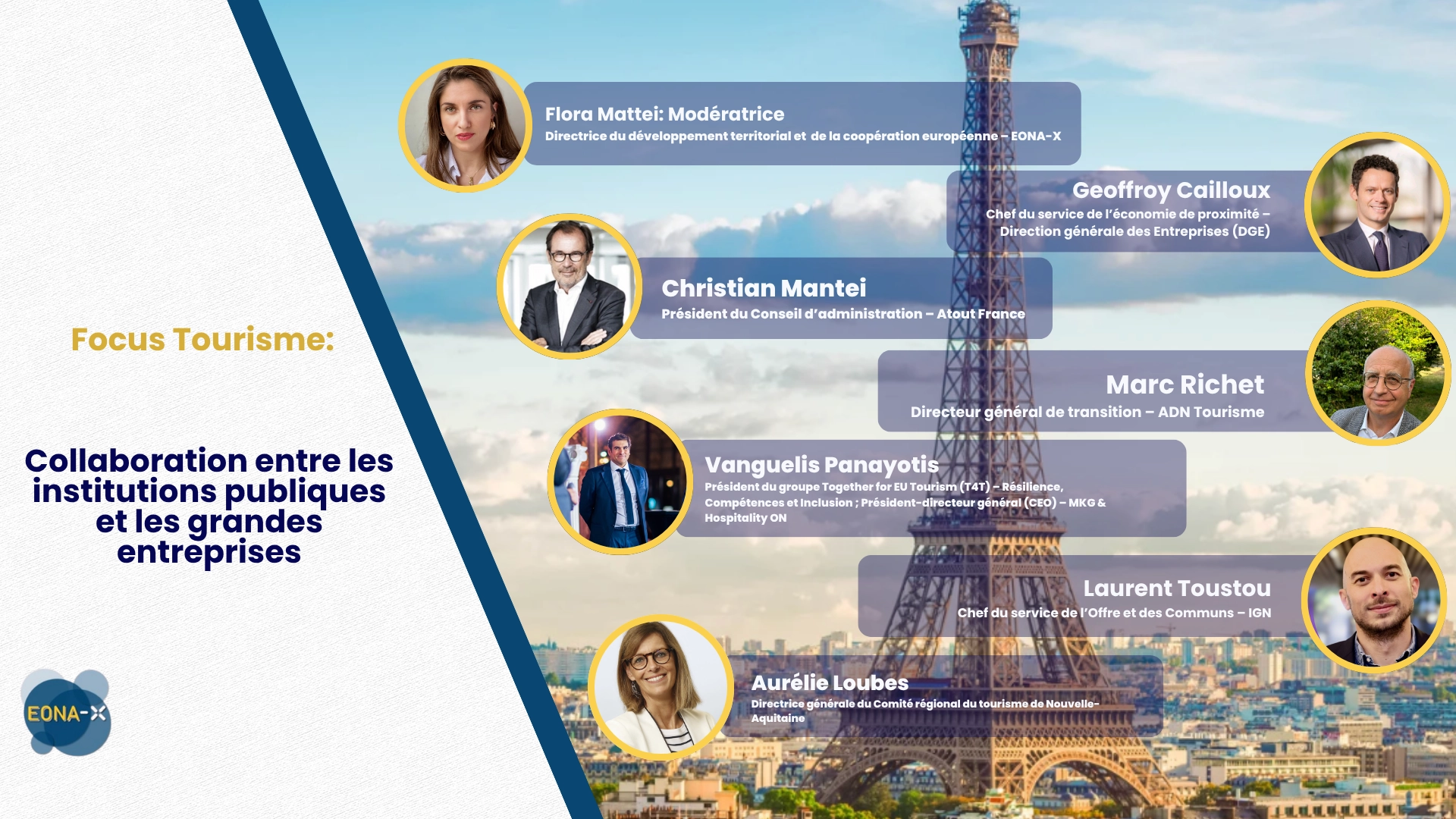
Opening the conversation, Geoffroy Cailloux, Head of the Local Economy Department at France’s Directorate General for Enterprise (DGE), reflected on how tourism data has evolved. For many years, tourism data was largely statistical, published once or twice a year and offering limited support for decision-making. Today, however, real-time data combined with AI has become a strategic asset. He highlighted ongoing discussions at both French and European levels aimed at placing data and artificial intelligence at the heart of tourism policy. For Cailloux, the key challenge is creating lasting cooperation between public and private actors. Since tourist destinations rarely follow administrative boundaries, data sharing must also transcend them. Better collaboration can help address issues such as overtourism, improve visitor flow management, and ultimately encourage travelers to discover more of France’s territories. As he noted, the goal is simple: tourists should gain by getting lost.
Building on that vision, Christian Mantei, Chairman of the Board of Atout France, emphasized that tourism has always been an industry driven by supply, but AI is fundamentally changing how travelers discover and engage with that offer. By combining customer preferences, behavioral data, and intelligent recommendations, AI can create highly personalized travel experiences while helping businesses improve revenue management and customer loyalty. He stressed that France possesses an enormous wealth of valuable tourism data held by both public institutions and private operators. However, unlocking its value requires a shared national strategy that clearly demonstrates the benefits of data sharing. As the world’s leading tourism destination, France cannot afford to remain a spectator in the AI revolution. For Mantei, tourism sovereignty increasingly depends on data sovereignty, making strong national leadership essential.
Shifting to the regional perspective, Aurélie Loubes, Director General of the Nouvelle-Aquitaine Regional Tourism Committee, described how data has evolved from a reporting tool into a strategic resource. As traveler behaviors change, tourism organizations must adapt by becoming trusted intermediaries capable of combining human expertise with territorial knowledge. She argued that public and private actors should no longer view each other as competitors when it comes to data, but rather as complementary partners working toward a common objective: delivering better experiences for visitors while creating value for destinations.
Looking at tourism through the lens of destination management, Marc Richet, Director General of ADN Tourisme, described the sector as increasingly becoming a collective endeavor. France already benefits from exceptional infrastructure, a diverse tourism offering, and strong international appeal, but the full potential of available data remains underutilized. By bringing data together within shared platforms, stakeholders can gain more precise insights into visitor behavior, support sustainable mobility, and better distribute tourist flows across territories. Richet also highlighted the growing importance of digital twins and predictive models, which can help anticipate future demand, manage infrastructure investments, and support long-term territorial planning. For him, data is not an objective in itself, but a powerful tool for building a more sustainable and resilient tourism model.
Offering a private-sector perspective, Vanguelis Panayotis, President of Together for EU Tourism (T4T) and CEO of MKG & Hospitality ON, argued that tourism may already represent one of Europe’s greatest success stories. Yet despite this strength, the sector has not progressed quickly enough in sharing and leveraging data. He called for greater ambition, stronger cooperation, and increased investment in collective initiatives. While AI will transform many aspects of the industry, he believes its greatest contribution may be enhancing the value of what remains uniquely human. Tourism ultimately relies on experiences, hospitality, and emotional connections—assets that Europe must continue to protect and strengthen through better collaboration between public and private stakeholders.
Closing the panel, Laurent Toustou, Head of Service for Offerings and Commons at IGN, focused on the role of trusted public infrastructures and shared data frameworks. He highlighted the importance of creating bridges between sectors and enabling public and private organizations to work with common tools and standards. Digital twins, in particular, offer powerful opportunities to model future scenarios, test public policies, and understand the interactions between tourism, transport, and territorial development. Advances in AI now make these simulations far more accessible than before, allowing decision-makers to anticipate change and make more informed choices. For Toustou, information itself has become a strategic resource, and Europe has the opportunity to structure its own data ecosystems around trusted governance and shared value creation.
All in all, the discussion demonstrated that the future of tourism will depend on far more than technology alone. Success will require trusted data-sharing frameworks, stronger partnerships between public and private actors, and a shared commitment to building a more sustainable, intelligent, and sovereign tourism ecosystem.
To discover how EONA-X is supporting this vision through collaborative data spaces and cross-sector innovation, visit the EONA-X website and join the conversation shaping the future of European tourism.