FR
The working group brings together Accor, Air France-KLM, Beti, G7, Instant System, SNCF, Capgemini, Digital New Deal, Inria and Linagora. Through a series of workshops, participants shared their experiences and perspectives to develop a common framework designed to be demonstrated and subsequently deployed.
Following the era of search engines, then applications and comparison platforms, travel is entering a new phase. Travellers no longer need to navigate between websites: they can entrust their intentions to an AI assistant capable of searching, comparing, recommending, booking and modifying an entire journey. It is now the customer’s agent that interacts directly with service providers.
This shift offers significant opportunities: smoother, more personalised distribution capable of coordinating services that are currently fragmented. However, it also introduces a risk: the emergence of a new layer of intermediation, particularly operated by major non-European AI assistants, which could capture customer attention, data, relationships and an increasing share of the value created. The mobility and tourism sectors are particularly exposed: their journeys involve multiple stakeholders, prices and availability change in real time, and inaccurate information negatively affects both travellers and service providers.
No single organisation can establish a credible trust framework for AI agents on its own. The response must be collective, interoperable and European: this is the fundamental purpose of the working group.
The report’s central message is clear: the challenge is not to reject AI agents, but to define the conditions under which they can access offers and take action, without reducing European service providers to invisible players.
For the working group, sovereignty means retaining the ability to decide who can access an offer, under which rights, for what purpose, with what level of traceability, and with the possibility of revoking access at any time. It also means maintaining operational continuity if an AI model, cloud service or protocol changes or disappears. This control must never come at the expense of travellers, who must retain access to fair comparisons, explainable recommendations and freedom of choice.
Beyond protection, the report identifies AI agents as a strategic opportunity for growth and innovation. By collaborating within a trusted framework, stakeholders can combine services that none could deliver independently, such as recognising loyalty benefits without repeated data entry, seamlessly connecting multiple services, or coordinating responses to travel disruptions.
An Operational Response: Governed Agent-to-Agent Distribution
The working group proposes an architecture built on the federated EONA-X data space, in which each stakeholder retains control over its data and access conditions. It is based on three mechanisms.
A verified agent: Before accessing an offer or triggering an action, every agent must be identified, qualified and subject to governance. A shared registry makes it possible to establish the agent’s identity, its operator, on whose behalf it acts, and what it is authorised to do, according to three levels of permission: read, recommend and act. Every sensitive action requires a verified identity, and any access can be revoked immediately.
A verified offer: Offers are delivered directly from their source, together with information on their provenance, freshness and conditions. The service provider is systematically identified in any recommendation involving sensitive decisions. Travellers therefore always know where an offer originates and whether it remains valid, while providers preserve their brand visibility.
A coordinated booking: For journeys combining multiple services, travellers provide a single, revocable consent, after which each provider executes its own part of the booking. Orchestration coordinates the process without centralising it: it does not capture the customer relationship, data or margins.
These mechanisms are embodied in a reference traveller journey, from the initial expression of intent through to journey monitoring and disruption management, which must comply with five fundamental principles: travellers remain in control, each provider retains control over its offers, only necessary data is exchanged, sources and decisions remain auditable, and no single component becomes a mandatory intermediary.
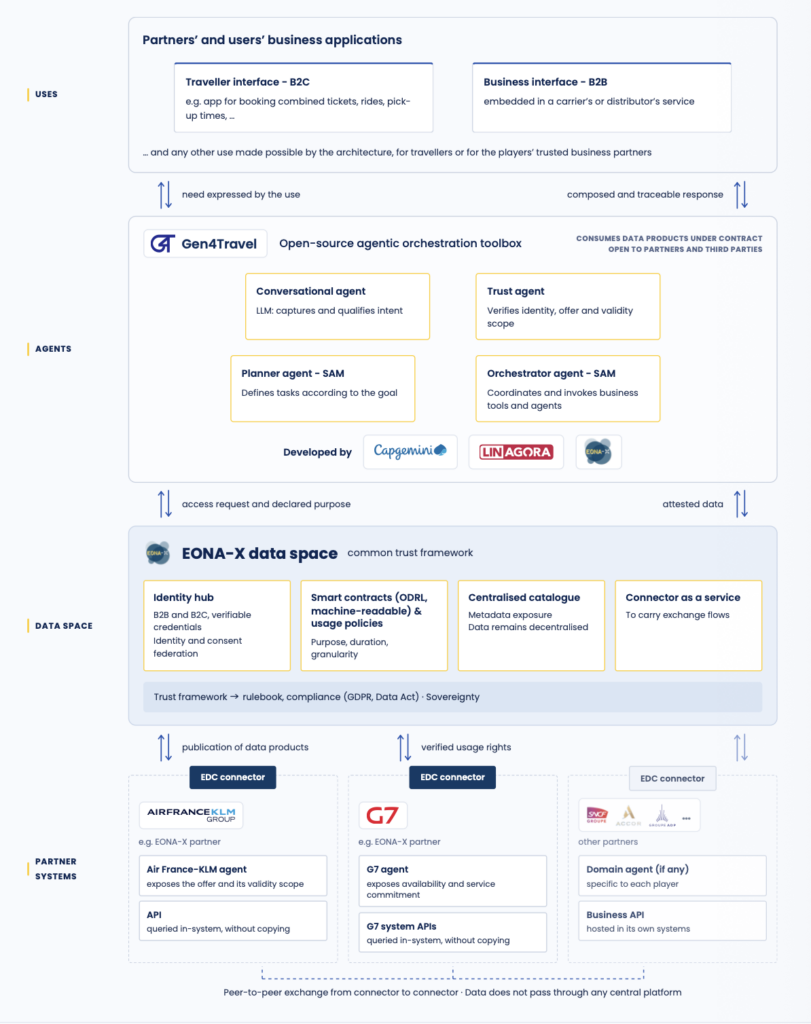
From a technical perspective, the architecture consists of four layers: partner applications designed for both travellers and professionals; the open-source Gen4Travel toolkit, whose agents capture intent, verify identities and offer validity, plan and orchestrate tasks; the EONA-X data space, which provides a shared trust framework managing identities, consent and usage policies; and, finally, partners’ information systems, where exchanges take place on a peer-to-peer basis, with no data passing through a central platform.
A framework that benefits the entire ecosystem
For travellers, this means smoother journeys, more reliable offers and greater personalisation, combined with increased transparency: they know where recommendations come from and retain control over their consent.
For service providers, it ensures continued visibility, clear brand attribution, a direct customer relationship and the ability to enforce their commercial rules throughout the distribution chain.
For the European ecosystem, it represents a credible, interoperable and scalable alternative to closed platforms, with EONA-X acting as a neutral guarantor of the shared framework rather than a commercial operator.
For technology partners, it provides a concrete environment for demonstrating AI agents, data spaces and verifiable identity solutions, as well as an opportunity to contribute to the standards of tomorrow.
Eight Recommendations for Taking Action
-
Place identity, mandates and action permissions at the heart of the framework.
-
Keep offers, prices and inventories at their source.
-
Preserve both providers’ control and travellers’ freedom of choice.
-
Standardise the exchange framework rather than locking in a specific technology.
-
Align orchestration with existing distribution and booking rules.
-
Make security, resilience and reversibility demonstrable.
-
Establish neutral, verifiable and economically sustainable governance.
-
Demonstrate the framework end-to-end through the Gen4Travel project before scaling it up.
ㅤㅤㅤ
ㅤㅤㅤ
Download the strategy note