FR
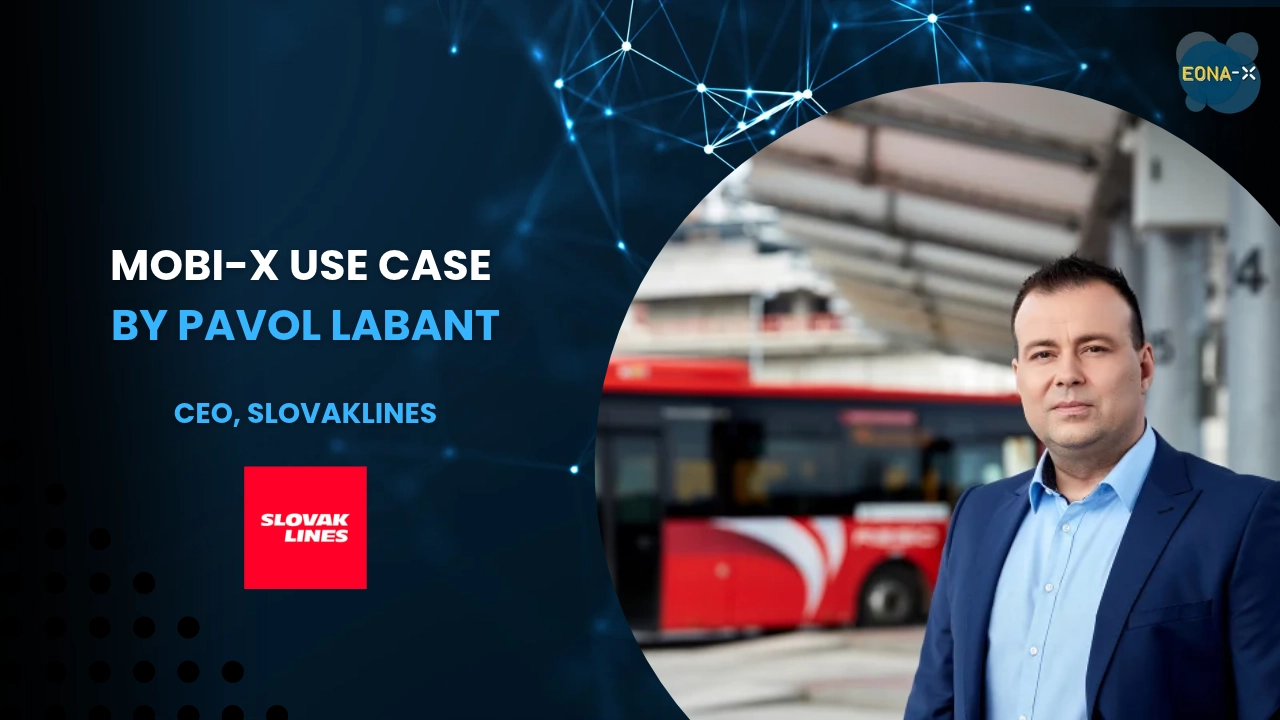
Turning Data Sharing into Business Value – Pavol Labant, Slovak Lines
How can competing transport operators use data sharing to create new business opportunities while keeping control of their data? During an EONA-X Data Dialogue, Pavol Labant, CEO of Slovak Lines, presented Mobi-X, a project bringing together Slovak Lines, Turancar and EONA-X to improve connections between Slovakia and Vienna.
The project demonstrates how a trusted data-space environment can help companies collaborate on a concrete business challenge, while allowing each organisation to keep control over the data it shares.
Watch Pavol’s intervention:
This project shows that a data space can create real business value. It’s not just theory
Enabling Collaboration Between Competitors
Slovak Lines and Turancar are two independent and competing coach operators. While both are looking for new opportunities to develop their business, sharing operational data requires a high level of trust and control.
Through the data space, each company connects its own systems and chooses which information to share. GPS data, timetables and live bus locations can be exchanged without creating a central database: each operator keeps control of its own data and decides what can be accessed by the other participant.
This approach made it possible for the two operators to work together on a shared mobility service while maintaining control over their respective data.
Finding Better Connections Between Slovakia and Vienna
The Mobi-X pilot focuses on connections between Nitra, Trnava, Bratislava and Vienna Airport. By analysing real GPS and timetable data, the project aimed to identify convenient transfer opportunities and make bus travel to Vienna Airport more predictable for passengers.
Data collected over 44 days provided more than 11,000 GPS records from the two operators. The analysis identified 47 potential transfer connections, including several combinations offering convenient journey times and transfer windows.
The results are now being used to develop a concrete service rather than remaining at the level of a technical pilot.
From Data Sharing to a New Mobility Service
The next step is the creation of a joint ticketing service between Slovak Lines and Turancar. Passengers will be able to combine the two operators in a single journey and purchase one ticket for the full connection to Vienna Airport or Vienna.
For the operators, this creates an opportunity to develop a new service, attract more passengers and increase revenue. For travelers, it aims to make connections between Slovakia and Vienna easier and more convenient.
Mobi-X therefore illustrates a practical application of data spaces: enabling independent companies to collaborate on shared services while keeping control of their own data.